How to Replace Underperforming Candidates Quickly Without Compromising Hiring Quality
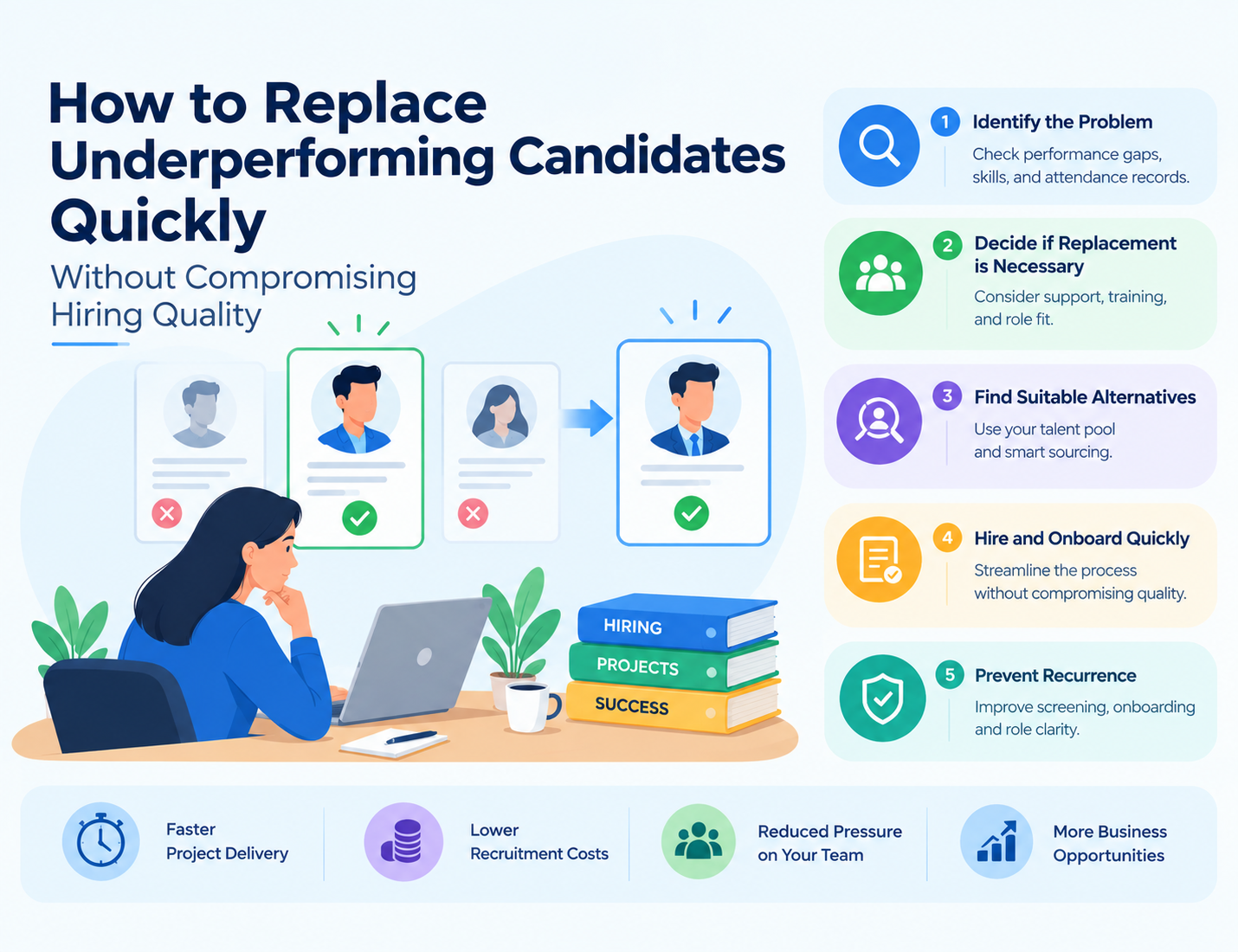
How to Replace Underperforming Candidates Quickly Without Compromising Hiring Quality
Category: Recruitment & Talent Acquisition
Hiring the right candidate is essential for business growth. But what happens when a new hire fails to meet expectations, lacks the required skills, misses important deadlines, or leaves shortly after joining?
For employers, an underperforming hire can mean delayed projects, additional recruitment costs, increased pressure on existing employees, and lost productivity. The challenge becomes even greater when the position is business-critical and needs to be filled quickly.
The solution is not simply to hire another candidate as fast as possible. Businesses need a structured approach to identify performance gaps, determine whether replacement is necessary, find suitable alternatives, and prevent the same problem from happening again.
Understanding how to replace underperforming candidates quickly can help recruitment teams reduce unnecessary delays, improve hiring decisions, and maintain business continuity.
In this guide, we will explore practical steps employers, HR professionals, and recruitment agencies can follow to manage candidate replacement efficiently while maintaining hiring quality.
What Does It Mean to Replace an Underperforming Candidate?
Replacing an underperforming candidate means finding a suitable alternative when a selected or recently hired person does not meet the role's essential requirements or can no longer fulfil the position.
This situation can occur at different stages of the recruitment process.
-
Before joining: A selected candidate declines the offer, fails to join, or withdraws at the last minute.
-
During onboarding: The candidate demonstrates a significant mismatch between the required skills and their actual capabilities.
-
After joining: An employee consistently fails to meet reasonable performance expectations despite receiving appropriate guidance and support.
-
\
-
During a probationary period: The employer identifies a documented mismatch between the role requirements and the employee's performance.
-
Each situation requires a different response. A candidate who never joins may need to be replaced through the existing recruitment pipeline, while an employee who has already joined may require performance feedback, support, a fair review process, and appropriate employment procedures.
Why Do Businesses Need to Replace Underperforming Candidates Quickly?
Delaying a necessary replacement can affect more than one department. When a critical position remains unfilled or an unsuitable match continues without resolution, the consequences can spread across the organization.
1. Project Delays and Missed Deadlines
An employee who lacks essential role-specific skills may struggle to complete assigned responsibilities within the expected timeframe. This can delay deliverables and affect other team members who depend on that work.
For example, a software development company may need an experienced backend developer to complete a client project. If the selected candidate cannot perform the required tasks, the project team may need additional support or a replacement with the appropriate technical skills.
2. Increased Recruitment Costs
Replacing a hire can involve additional sourcing, interviews, assessments, onboarding, and administrative work.
Businesses can reduce avoidable costs by maintaining a shortlist of qualified candidates, documenting hiring requirements, and evaluating candidates consistently from the beginning.
3. Additional Pressure on Existing Employees
When a role is not being performed effectively, other employees may need to take on additional work. If this continues, it can affect productivity, workload distribution, and team morale.
4. Lost Business Opportunities
In client-facing and revenue-generating roles, a staffing gap can affect lead follow-ups, customer service, project delivery, or sales targets.
A structured replacement process helps organizations respond to these challenges without sacrificing the quality of the next hiring decision.
How to Replace Underperforming Candidates Quickly: 7 Practical Steps
The following process helps employers balance speed, fairness, and hiring quality.
Step 1: Identify the Actual Performance Problem
Before deciding to replace a candidate, identify the specific issue.
Is the candidate missing deadlines? Do they lack a skill that was essential to the role? Are expectations unclear? Have they received adequate training, tools, and guidance?
Review measurable evidence rather than relying on general impressions.
For example, instead of saying, "The candidate is not performing well," document the specific issue: "The employee has missed three agreed project milestones and has not completed the required deliverables despite receiving the necessary instructions and resources."
This creates a clearer basis for deciding whether the issue can be resolved through support or requires further action.
Step 2: Determine Whether Replacement Is Necessary
Not every performance gap means an employee should be replaced.
Some problems arise from inadequate onboarding, unclear responsibilities, insufficient training, unrealistic deadlines, or a mismatch between the assigned work and the employee's experience.
Discuss the issue with the relevant manager and HR team. Explain the expectations, invite the employee's perspective, and determine whether reasonable support can address the problem.
Where improvement is unlikely or the role requirements remain unmet, consider the appropriate next steps under company policy and applicable employment requirements.
For employees who have already joined, document feedback and follow the relevant contractual and legal procedures. Do not treat an employee's protected status, disability, or request for a reasonable accommodation as evidence of poor performance.
Step 3: Reopen the Recruitment Process Immediately
Once a replacement decision has been approved, avoid starting the entire recruitment process from scratch if suitable candidates are already available.
Review:
For example, if a company needs a software developer who can independently troubleshoot production issues, practical debugging ability may be more important than simply having a particular degree or number of years of experience.
A clearer job profile helps recruiters focus on relevant evidence rather than making decisions based on resumes alone.
Step 5: Use Structured Screening and Skill Assessments
Speed should not eliminate proper candidate evaluation.
To improve hiring accuracy, use a consistent screening process that checks whether applicants can meet the actual requirements of the position.
Depending on the role, this may include:
-
Resume and experience verification.
-
Structured interviews based on job-related competencies.
-
For technical positions, a practical assessment may reveal gaps that are difficult to identify through an interview alone. For sales positions, a role-play exercise may help assess communication and objection-handling skills.
-
Practical skill assessments or work samples.
-
Reference checks where appropriate and conducted with permission.
-
Communication and problem-solving evaluations relevant to the job.
-
Verification of relevant qualifications and employment details.
-
\
-
Verification of relevant qualifications and employment details.
-
For technical positions, a practical assessment may reveal gaps that are difficult to identify through an interview alone. For sales positions, a role-play exercise may help assess communication and objection-handling skills.
Use consistent, job-related criteria for all candidates. Avoid unnecessary assessments that create delays without providing meaningful information.
Step 6: Coordinate Interviews and Decisions Efficiently
Recruitment delays often occur because interviewers are unavailable, feedback arrives late, or hiring approvals remain pending.
To prevent these problems, establish a clear decision-making process.
-
Assign one person to coordinate the replacement hiring process.
-
Confirm the required interviewers and approval authority.
-
Schedule interviews in coordinated time slots.
-
Share the evaluation criteria with interviewers in advance.
-
Collect structured feedback promptly after each interview.
-
Communicate the decision and next steps to candidates without unnecessary delay.
-
A coordinated process helps hiring managers compare candidates consistently and reduces avoidable waiting time.
Step 7: Confirm the Offer and Prepare for Successful Onboarding
Selecting a replacement is not the final step. The new hire must also understand the role and have the support needed to perform effectively.
Before issuing an offer, confirm compensation, role responsibilities, joining availability, relevant conditions, and any required checks.
Once the candidate accepts, prepare an onboarding plan covering:
-
Role expectations and responsibilities.
-
Access to systems, tools, and resources.
-
Initial training and team introductions.
-
Early deliverables and performance measures.
-
Regular feedback and review meetings.
-
Effective onboarding can help the new employee understand what success looks like and reduce the risk of another avoidable mismatch.
A Practical Timeline for Faster Candidate Replacement
The timeline below is an illustrative operational target, not a guarantee. Actual timelines depend on the role, candidate availability, notice periods, assessment requirements, and approval processes.
Stage Suggested target Key action Identify the issue Day 1 Review documented evidence and confirm the problem Approve the replacement process Days 1–2 Align HR and the hiring manager Reopen the shortlist Days 1–3 Contact qualified existing candidates Screen and assess candidates Days 2–5 Conduct focused interviews and relevant assessments Finalize selection Days 4–7 Complete feedback, approvals, and required checks Issue and confirm the offer Days 5–10 Confirm terms and joining availability Complete onboarding According to joining date Set expectations and provide role-specific support For an urgent vacancy, some stages can run in parallel. For example, recruiters can review the existing talent pool while the hiring manager finalizes the role's essential requirements.
However, checks should not be skipped simply to meet an internal deadline.
How to Prevent the Same Hiring Mistake From Happening Again
Replacing an underperforming hire addresses the immediate problem. Improving the recruitment process helps reduce the likelihood of repeating it.
Improve Job Descriptions
Clearly describe the role's responsibilities, essential skills, working arrangements, and performance expectations. Avoid vague descriptions that attract candidates whose experience does not match the actual work.
Evaluate Skills, Not Just Resumes
A strong resume does not automatically demonstrate practical competence. Use appropriate, consistent assessments to understand how candidates approach the tasks they will perform.
Set Realistic Expectations Before Hiring
Explain the job's responsibilities, reporting structure, compensation, work arrangements, and performance measures during recruitment. This helps both parties assess whether the opportunity is suitable.
Maintain a Qualified Talent Pool
Keep records of suitable candidates who have been evaluated for relevant roles, subject to appropriate consent, data protection, and retention practices.
A well-maintained talent pool can reduce sourcing time when a selected candidate withdraws or an unexpected vacancy arises.
Strengthen Onboarding and Early Feedback
Provide new employees with clear priorities, access to required resources, and regular feedback. Address concerns early instead of waiting until a performance problem becomes difficult to resolve.
Track Recruitment Performance
Measure the results of your replacement process using relevant indicators, including:
-
Time to fill the vacancy.
-
Time from approval to shortlist.
-
Interview-to-offer conversion rate.
-
Offer acceptance rate.
-
New-hire retention.
-
Early performance against agreed role expectations.
-
Reasons for failed hires or candidate withdrawals.
-
Review these metrics periodically to identify where the hiring process needs improvement.
How a Recruitment Platform Can Help Replace Candidates Faster
Managing candidate information across spreadsheets, email threads, and separate documents can make urgent recruitment more complicated.
A suitable recruitment platform can help teams organize candidate profiles, track application stages, maintain interview feedback, and identify previously shortlisted applicants.
Depending on the platform's capabilities, it may also support workflow automation, recruitment reporting, candidate communication, and coordination between recruiters and hiring managers.
When evaluating a recruitment solution, look for capabilities that address your specific bottlenecks:
-
Centralized candidate records.
-
Searchable candidate profiles.
-
Recruitment pipeline tracking.
-
Interview scheduling and feedback.
-
Recruitment performance reporting.
-
Clear ownership of recruitment tasks.
-
Appropriate access controls and data protection.
-
A platform can improve visibility and coordination, but it cannot guarantee that a replacement candidate will be available immediately or perform successfully. Hiring outcomes still depend on the quality of the selection process and the suitability of the candidate.
How Mellow Vault Can Fit Into Your Recruitment Strategy
Finding the right replacement begins with identifying the skills and experience required for the role.
Mellow Vault focuses on helping bridge the skills gap, support career development, and help organizations hire with greater confidence.
For employers seeking to strengthen their recruitment process, the priority should be to define role requirements clearly, evaluate relevant skills, and make informed decisions about candidate suitability.
A structured approach to talent discovery can help organizations focus on candidates whose capabilities align with their business requirements.
If your organization is reviewing its hiring approach or looking for ways to improve how it identifies suitable talent, explore the recruitment-related offerings available through Mellow Vault.
Review the current services and platform capabilities to determine how they may support your recruitment requirements.
Frequently Asked Questions
1. How can I replace an underperforming candidate quickly?
Start by confirming the issue, obtaining the necessary approval, and reviewing candidates already available in your talent pool. Use structured screening, coordinate interviews efficiently, and confirm joining availability before making an offer.
2. How long does it take to replace an underperforming employee?
The time required depends on the role, candidate availability, recruitment requirements, and notice periods. An existing shortlist may help accelerate the process, but specialized positions can take longer to fill.
3. Should an underperforming employee always be replaced?
No. First determine whether the problem results from inadequate training, unclear expectations, insufficient resources, or a genuine mismatch with the role. Appropriate coaching and support may resolve some performance issues.
4. How can recruiters reduce the risk of another failed hire?
Recruiters can improve job descriptions, use structured interviews, assess relevant practical skills, verify appropriate information, and communicate role expectations clearly. Consistent onboarding and early feedback also help.
5. What is the difference between a replacement candidate and a replacement guarantee?
A replacement candidate is an alternative applicant selected to fill a vacancy. A replacement guarantee is a contractual service commitment that may allow an employer to receive a replacement search or other remedy if a placement fails within specified conditions. The exact terms depend on the recruitment provider's agreement.
6. Can a recruitment platform speed up candidate replacement?
Yes, a suitable platform can help organize candidate records, shortlist qualified applicants, coordinate interviews, and monitor hiring progress. The extent of the benefit depends on the platform's features and how effectively the recruitment team uses them.
7. What should HR consider before replacing an employee in India?
HR should review the employment contract, applicable policies, relevant central and state requirements, and any applicable notice, disciplinary, or termination procedures. The appropriate process depends on the employee's circumstances and the applicable law. Seek qualified legal advice when necessary.
Conclusion
Replacing an underperforming hire quickly requires more than publishing another vacancy. Businesses need a clear process for identifying the problem, deciding on the appropriate response, reviewing existing candidates, conducting focused assessments, and preparing the successful replacement for the role.
The most effective approach balances speed with fair treatment and sound hiring decisions. By maintaining a qualified talent pool, setting clear expectations, improving candidate assessments, and tracking recruitment performance, organizations can reduce avoidable delays and improve their hiring process.
For businesses looking to strengthen their approach to talent discovery and recruitment, Mellow Vault offers an opportunity to explore solutions aligned with its focus on skills, careers, and hiring confidence.
\