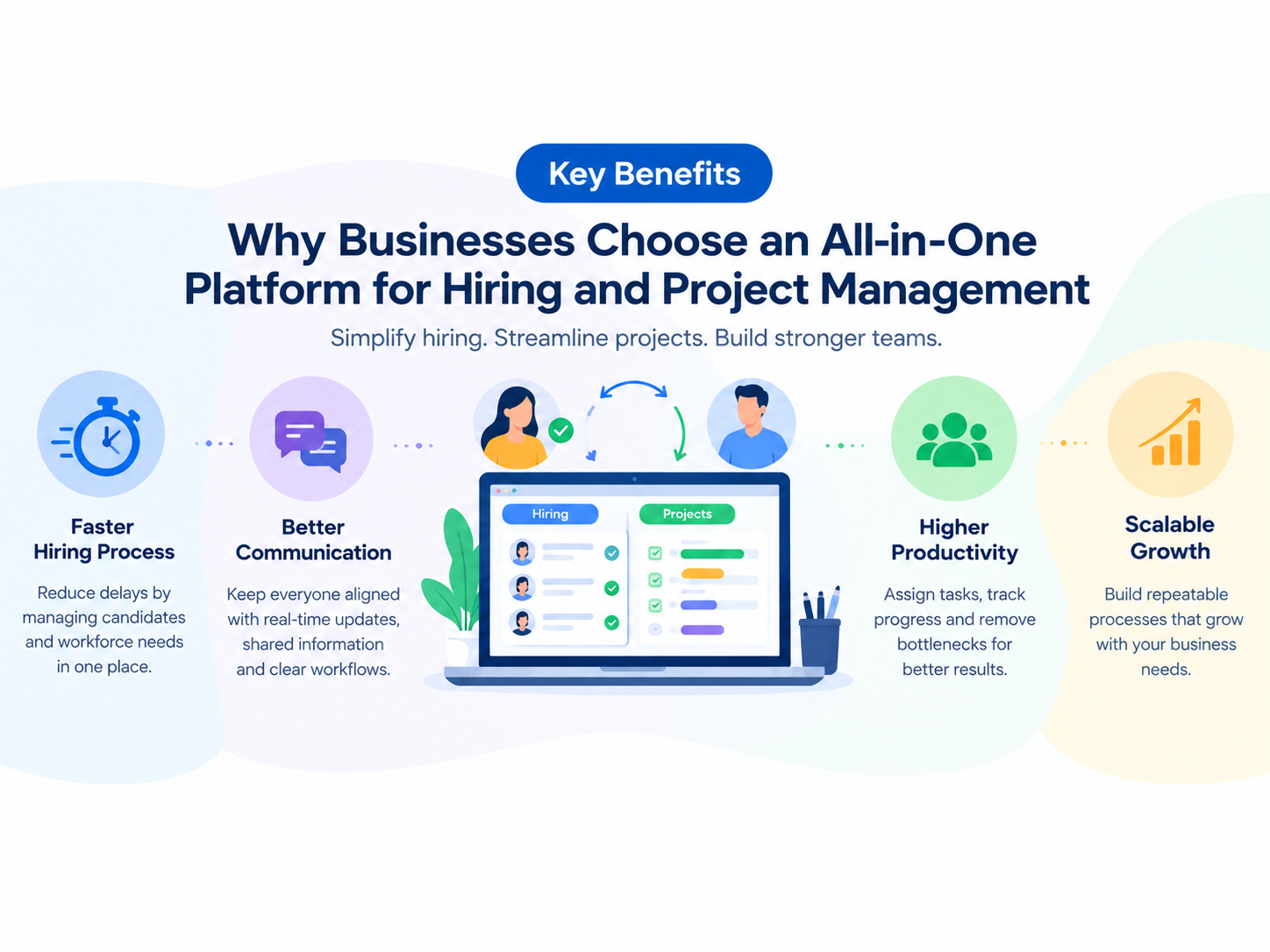
All-in-One Platform for Hiring and Project Management: A Smarter Way to Build and Manage Teams
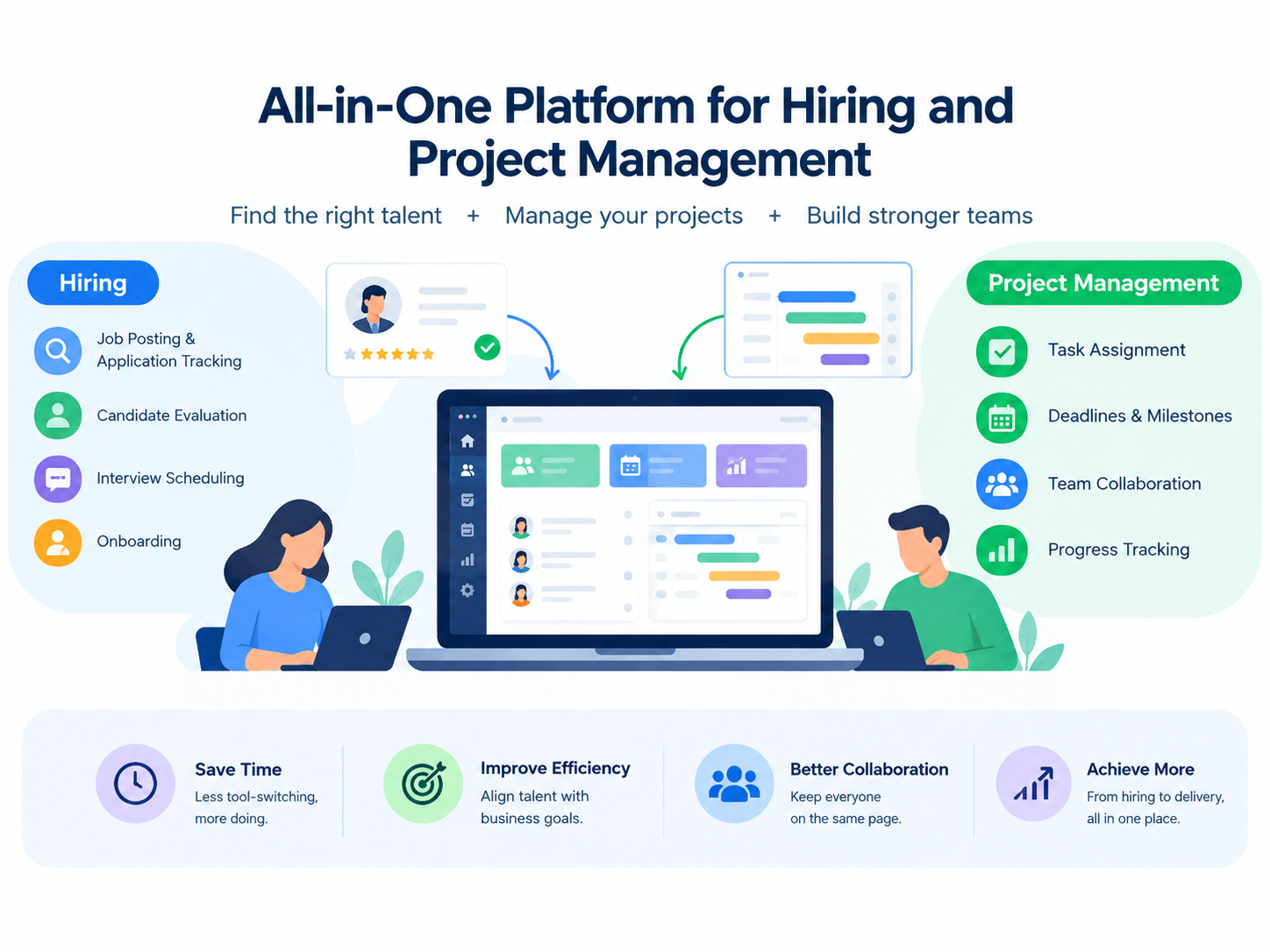
2.All-in-One Platform for Hiring and Project Management: A Smarter Way to Build and Manage Teams
Introduction: Hiring the Right People Is Only the Beginning
Every successful project starts with the right people, a clear plan, and effective coordination. However, many businesses still manage hiring, candidate communication, task assignments, project deadlines, and team collaboration through separate tools. This can create unnecessary complexity, slow down decision-making, and make it difficult to track progress.
Imagine finding the right candidate, assigning responsibilities, coordinating with your team, and monitoring project progress through a connected workflow. Instead of switching between multiple systems, your business could manage important activities more efficiently.
This is why businesses are increasingly interested in an all-in-one platform for hiring and project management—a solution designed to bring talent acquisition and project coordination closer together.
Whether you are a startup, a growing business, a recruitment agency, or an established organization, understanding how these platforms work can help you make better decisions about your hiring and project management processes.
What Is an All-in-One Platform for Hiring and Project Management?
An all-in-one platform for hiring and project management is a digital solution that brings recruitment activities and project coordination into one connected environment, or integrates the tools responsible for these functions.
The hiring component helps organizations attract, evaluate, and select suitable candidates. The project management component helps teams organize tasks, assign responsibilities, set deadlines, collaborate, and monitor progress.
Depending on the platform, these functions may include:
- Recruitment management: Organizing job openings, applications, and candidate information.
- Candidate evaluation: Helping recruiters assess candidates against job requirements.
- Task and project tracking: Assigning work, setting deadlines, and monitoring completion.
- Team collaboration: Keeping relevant discussions, updates, and responsibilities organized.
- Progress monitoring: Giving managers visibility into hiring activities and project milestones.
- Workflow coordination: Connecting recruitment decisions with upcoming workforce requirements.
The exact capabilities vary by provider. Before choosing a solution, businesses should verify which features are built in and which require third-party integrations.
Why Do Businesses Need Hiring and Project Management in One Workflow?
Hiring and project execution are closely connected. A business might have a new client project ready to begin but lack the developers, designers, recruiters, or other professionals required to deliver it.
When recruitment and project planning operate independently, teams can struggle to align talent availability with business priorities.
Here are some common challenges an integrated approach can help address.
1. Recruitment Delays Can Affect Project Deadlines
When a critical position remains vacant, existing employees may need to manage additional responsibilities, or a project may have to wait until the right person joins.
Connecting workforce planning with project requirements can help managers identify talent needs earlier and communicate hiring priorities more clearly.
For example, a software company preparing to launch a new application may need frontend developers, backend developers, and quality assurance professionals. Planning these requirements alongside project milestones helps the recruitment team understand which roles need immediate attention.
2. Too Many Tools Can Create Communication Gaps
Recruiters may use one system for candidates, project managers another for deadlines, and department heads spreadsheets for workforce planning.
This fragmented approach can lead to duplicated information, missed updates, and confusion about responsibilities.
An integrated platform can reduce unnecessary switching between tools and provide a clearer view of relevant information, depending on its integration capabilities.
3. Managers Need Better Visibility Into Progress
Recruitment and project delivery both involve multiple stages.
A recruitment process may include application screening, interviews, evaluations, and selection. A project may involve planning, task allocation, execution, review, and delivery.
Tracking these activities systematically helps teams identify bottlenecks and make informed decisions before delays become serious problems.
4. Growing Businesses Need Repeatable Processes
A small team might manage hiring and project coordination through informal conversations. As the organization grows, that approach becomes harder to maintain.
Documented workflows, clearly assigned responsibilities, and consistent progress tracking help businesses establish processes that can scale with their needs.
Essential Features of an All-in-One Hiring and Project Management Platform
Not every business needs the same functionality. However, several capabilities are worth evaluating when comparing solutions.
1. Centralized Recruitment Management
Recruiters need an organized way to manage job openings, candidate profiles, applications, interviews, and hiring decisions.
A recruitment management system can help reduce manual administration and keep candidate information accessible to authorized team members.
2. Candidate Screening and Evaluation
Finding applicants is only one part of recruitment. Organizations must also evaluate whether candidates possess the relevant skills, experience, and qualifications.
Look for features that support structured evaluation, interview coordination, and consistent decision-making. Where skills verification is important, check whether the platform offers assessments or integrates with appropriate assessment tools.
3. Project Planning and Task Allocation
Project managers need to divide larger objectives into manageable tasks, assign owners, establish deadlines, and monitor progress.
Useful project management capabilities may include task boards, milestone tracking, priority settings, deadline reminders, and workload visibility.
4. Team Collaboration and Communication
A shared workflow can make it easier for recruiters, hiring managers, and project teams to exchange updates and coordinate decisions.
Check whether the platform includes messaging, comments, notifications, document sharing, or integrations with the collaboration tools your team already uses.
5. Reporting and Performance Tracking
Reports help businesses understand where time is being spent and where processes need improvement.
For recruitment, useful metrics may include time to hire, candidate conversion rates, and offer acceptance rates. For project management, teams may track milestone completion, overdue tasks, workload distribution, and delivery timelines.
6. Integrations and Data Security
An all-in-one solution should fit your existing business processes rather than introduce new complications.
Before investing, evaluate integration options, user permissions, data handling practices, backup arrangements, and the security controls appropriate for your organization.
How an Integrated Platform Can Improve the Hiring Process
A well-designed workflow can help connect talent requirements with business objectives.
Consider a company that receives a new software development project. The project manager identifies the required skills and expected delivery date. The hiring team then prioritizes relevant positions, tracks candidates, coordinates interviews, and communicates hiring progress to the people responsible for delivery.
Once the appropriate professionals are available, managers can plan onboarding, clarify responsibilities, and organize the work required for the project.
This approach can support:
- Better coordination between recruitment and delivery teams.
- Clearer visibility into hiring priorities.
- More organized candidate management.
- Earlier identification of potential staffing gaps.
- Improved planning around deadlines and resource requirements.
These benefits depend on how the platform is configured and used. Technology supports good processes, but it cannot replace clear communication, sound hiring decisions, or effective management.
All-in-One Platform vs. Separate Hiring and Project Management Tools
Should your business choose one integrated solution or continue using specialized tools? The answer depends on your team's size, complexity, budget, and existing systems.
|
Factor |
Integrated platform |
Separate specialized tools |
|
Information management |
Can bring related workflows together |
May require integrations or manual transfers |
|
User experience |
Potentially fewer systems to manage |
Teams may need to learn multiple interfaces |
|
Flexibility |
Depends on available features |
Allows selection of specialist tools |
|
Implementation |
May simplify coordination, but setup still matters |
Can require additional integration work |
|
Cost |
Depends on pricing and required modules |
Depends on subscriptions and integration costs |
|
Scalability |
Depends on product capabilities |
Can offer flexibility across specialized needs |
The best choice is the solution that fits your actual workflow. An all-in-one platform is not automatically better if it lacks essential features. Similarly, several specialized tools can work well when their integrations are reliable and responsibilities are clearly defined.
Who Can Benefit From an All-in-One Hiring and Project Management Platform?
Startups and Small Businesses
Startups often operate with limited resources and need to coordinate hiring, product development, and business operations efficiently. An integrated workflow may help founders maintain visibility without introducing unnecessary administrative overhead.
Recruitment Agencies
Recruitment agencies manage multiple clients, vacancies, and candidates simultaneously. Recruitment-focused tools can help organize these activities, while connected project workflows may support internal task coordination and client delivery.
IT and Software Development Companies
Technology companies frequently hire for specific projects, skill requirements, and delivery schedules. Coordinating talent acquisition with project planning can help teams identify upcoming staffing needs and prepare for new assignments.
Growing Enterprises
Larger organizations may need standardized hiring processes, clear approval structures, and consistent reporting across departments. Integration can improve coordination, provided the solution supports their governance and security requirements.
Educational Institutions and Early-Career Talent Programs
Institutions working with employers may need to coordinate candidate readiness, employer requirements, assessments, and placement activities. Recruitment platforms can support these processes, while project management tools can help organize associated programs and activities.
How to Choose the Right Platform for Your Business
Choosing software should begin with your business requirements, not a list of attractive features.
Follow these steps before making a decision.
Step 1: Identify your biggest operational challenge.
Determine whether your main problem is finding suitable candidates, managing applications, coordinating project work, or connecting these activities.
Step 2: List your essential features.
Separate must-have requirements from optional features. This prevents you from paying for functionality your team will not use.
Step 3: Map your current workflow.
Document how a hiring requirement moves from approval to recruitment and how a project moves from planning to delivery. Identify where information gets lost or work is delayed.
Step 4: Check integrations and ease of use.
Evaluate whether the platform works with your existing HR, communication, reporting, and project management systems.
Step 5: Review pricing and scalability.
Consider subscription costs, implementation, training, integrations, user limits, and future business requirements.
Step 6: Test the platform with a real workflow.
Use a representative hiring requirement or project to evaluate usability, reporting, collaboration, and overall suitability before committing.
How Mellow Vault Fits Into the Modern Hiring Landscape
Finding suitable talent is a critical part of building successful teams. Organizations need more than a large pool of applicants; they need a reliable way to connect job requirements with relevant candidates and make informed hiring decisions.
Mellow Vault is positioned around helping bridge the skills gap, support career growth, and help organizations hire with greater confidence.
For employers and recruiters, the first step is to clearly define the skills and experience a role requires. A structured recruitment process can then help teams assess relevant candidates, coordinate hiring activities, and make better-informed decisions.
For candidates, understanding employer expectations and developing relevant skills can improve their readiness for career opportunities.
Businesses evaluating Mellow Vault should explore its current recruitment offerings, candidate-related services, and available platform capabilities to determine how they fit into their existing hiring workflow.
If your organization is looking to improve how it discovers and evaluates talent, visit the Mellow Vault website to learn more about its approach to recruitment and workforce readiness.
Best Practices for Connecting Hiring With Project Management
Even the right software requires effective processes to deliver value. Consider these practices when connecting talent acquisition with project execution.
Plan Hiring Around Real Business Needs
Define upcoming projects, required skills, estimated workloads, and expected start dates before prioritizing vacancies.
Establish Clear Ownership
Assign responsibility for job approvals, candidate evaluation, hiring decisions, project tasks, and milestone reviews. Every important activity should have a clear owner.
Track Meaningful Metrics
Avoid measuring success through activity counts alone. Evaluate hiring quality, process efficiency, project progress, and business outcomes together.
Keep Information Updated
Outdated candidate records, inaccurate deadlines, and incomplete task statuses reduce the usefulness of any management platform. Establish clear expectations for updating records.
Review Workflows Regularly
Use feedback from recruiters, candidates, managers, and project teams to identify friction and improve the process over time.
The Future of Hiring and Project Management
Businesses increasingly need to respond to changing skill requirements, distributed teams, and evolving project priorities. As recruitment technology and workflow automation develop, organizations have more opportunities to connect talent planning with operational execution.
Automation may help with repetitive administrative work, reminders, scheduling, and reporting. However, human judgment remains important when assessing candidates, making hiring decisions, resolving team challenges, and setting priorities.
The objective is not simply to place every business activity inside one system. It is to make the movement from identifying a business need to finding the right people and delivering the work more coordinated, transparent, and manageable.
Frequently Asked Questions
1. What is an all-in-one platform for hiring and project management?
It is a software solution that combines, or integrates, recruitment workflows with project planning, task coordination, collaboration, and progress tracking.
2. Can hiring software also manage projects?
Some platforms provide both recruitment and project management capabilities. Others specialize in hiring and connect with external project management tools. Businesses should verify the available features before selecting a solution.
3. What are the benefits of combining hiring and project management?
Potential benefits include improved coordination, greater visibility into staffing requirements, fewer manual handoffs, clearer task ownership, and better alignment between talent availability and project deadlines.
4. Is an all-in-one platform suitable for small businesses?
It can be, particularly when a business wants to simplify workflows and reduce unnecessary tool switching. The right choice depends on the company's needs, budget, and team size.
5. How can businesses measure the success of an integrated platform?
Businesses can evaluate time to hire, candidate conversion rates, recruitment costs, hiring quality, task completion, project milestone performance, and user adoption. Metrics should reflect the organization's actual goals.
6. How can Mellow Vault help businesses with recruitment?
Mellow Vault focuses on connecting skills, career opportunities, and employer hiring needs. Businesses should review its current services and platform features to identify the most relevant recruitment support for their requirements.
Conclusion: Connect Talent With Business Goals
Recruitment and project execution are closely linked. Businesses that understand their talent requirements, organize their workflows, and maintain clear communication are better positioned to manage growth and respond to new opportunities.
An all-in-one platform for hiring and project management can help connect these activities, provided its capabilities match the organization's requirements. Before choosing a solution, evaluate its recruitment features, project management functions, integrations, reporting, and scalability.
For organizations seeking to improve talent discovery and hiring confidence, Mellow Vault offers a starting point for exploring how skills and recruitment needs can be brought closer together.
Article Gallery & Visuals (1)
1 PhotosClick on any photo to open and inspect in full resolution.